
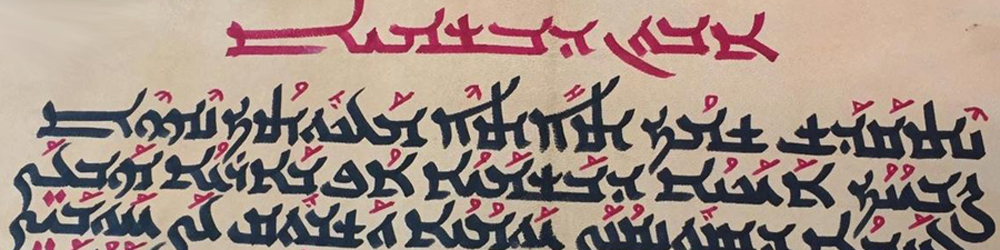
Page content
ToggleOur Father English / Our Father Aramaic / Our Father and Mother
Our Father, who art in heaven,
Abwûn d'bwaschmaâja
Father and mother of the cosmos, primal source of love.
Hallowed be Thy name
Nithkâdash shemach
Prepare the space of our hearts so that we may experience your light and your sound in peace.
Thy kingdom come
Têtê malkuthach.
Let your reality reveal itself.
Thy will be done on earth as it is in heaven
Nehwê tzevjânach aikâna debaschmâja af ter'arhan
Your desire: a heaven and earth, that we may discover your love in ours.
Give us this day our daily bread
Hawlân lachma de sunkanân jaomâna
Give us day by day what we need in bread and insight.
And forgive us our trespasses
as we forgive those who trespass against us
Aikâna daf chenân schvochen le chaijabên
Waschboklân chaubên wochtahên
Loosen the bonds of our faults, as we also release,
which binds us to the entanglement and guilt of others.
And lead us not into temptation
but deliver us from evil
Wi – lah tochlân linesjuna ela patzân min bischa
Lead us in our temptation.
Protect us from false desires, and free us from error and evil.
For Thine is the kingdom, and the power, and the glory, forever and ever
Metol dilachie malkutha wahaila wa-tesch-bay l'ahlâm almîn
For yours is the kingdom of love and peace,
the fullness of life and the sound of the cosmos that renews everything from age to age.
Amen.
Amen.
I affirm all this with my whole being.
The Lord's Prayer
Aramaic OUR FATHER AND MOTHER –
Abwûn d'bwaschmaâja
Background and comparison
The Lord's Prayer – Many Christians, including us, have been praying it for years; it is the most unifying and well-known prayer in Christianity. But what does it mean to me – what lies behind our Lord's Prayer? We'll approach the Lord's Prayer differently – from Aramaic, from a different translation: the Aramaic Our Father and Mother, translated by Franz-Xaver Jans Scheidegger. The Aramaic Our Father and Mother is a retranslation of the Greek Lord's Prayer (as it is recorded in the Bible) into Aramaic, the language spoken by Jesus. The Peshitta – the Aramaic-Syrian Bible – was used as a guide. This prayer was then retranslated into English, or rather, German, by capturing its meaning. It was, so to speak, "sensing" the words. To what extent does this translation reflect what Jesus truly meant? Here you can learn more about the culture and language area of Aramaic.
Cultural and linguistic area of origin and tradition
- Jesus himself spoke Aramaic, similar to Hebrew. His images and his way of thinking were shaped by this language and culture. For example, this language does not have linear thinking as we are familiar with it. There is no past or future tense for verbs; the context determines how it is understood. However, there is a so-called "intensive form" of the verb; something is done with intensity. This alone makes it clear that the attitude towards life was different. This is also evident in the difficulty of translating the name of God in Exodus 3 (which Moses learns at the burning bush): I am there; or: I am who I am; I will be who I am; I will be who I was; I am who I am there; ….
- Furthermore, Oriental language is very onomatopoeic and body-oriented; external events are perceived holistically in the body; the language is poetic and rich in imagery. It thrives on being ambiguous, meaning, and enabling many things.
- The language survived less through the written word, but rather through narrative traditions. Words and stories were meant to touch, move, convey meaning, and create an atmosphere (around a campfire or in a Jewish study house). We still know the magic of oriental narrative today.
In addition, the Oriental understanding of truth, even today, is different from the Western understanding of the Greek/Roman tradition, which is characterized by reason and ratio. Oriental: The description that draws me into the experience is true. As they say: 5 Jews, 7 opinions, and that was by no means a problem; rather, what was at issue was somehow "in between." In the attempts to resolve the conflict in the former Yugoslavia, a major problem lay in communication. In the Quran, they strive for a literal understanding – which remains difficult even today.
- The first Christians from the Aramaic-speaking region passed on their liberating experiences, the Gospel (Greek, literally "Good News"), orally in the Semitic narrative tradition. Among them were Jewish Christians and Gentile Christians. Palestine was occupied by the Romans at the time, but many Greeks also lived there; for both, written communication was already a cultural asset. The Greeks wrote the New Testament, in the form we know it, in their language. This was soon translated into Latin, which then became the church language of the Roman Christians. Both languages reflect a completely different way of thinking, much more spiritualized, with differentiated tenses and much more precise formulations. Paul himself was a Roman citizen and wrote in Greek. The experiential horizon of Jesus' message, as well as his linguistic images, had to be transferred to a different cultural background. The Semitically formulated and experienced message was transformed by Greek and Roman thought. In addition, early translation errors shaped entire centuries.
- When the texts to be included in the New Testament were selected at the Council of Nicaea in the early 4th century, most of the (oral) traditions in Coptic, Syriac, Hebrew, and Aramaic were excluded. Emperor Constantine desired a uniform, universally applicable religious code that corresponded to Western and Roman thought; the others were excluded.
However, some of the ancient Aramaic traditions are preserved in the churches of the Middle East.
- The Peshitta, the Aramaic Bible, which dates back to the 4th century and is based on oral and ancient Aramaic written traditions, claims to have preserved the more original narrative flow.
- Today, linguists are attempting to make the old narrative images accessible again and return to the ambiguity implicit in the words themselves. They are trying to trace the etymologies that were so vivid back then. However, this research has not yet reached German-speaking theology. Various attempts at translation are now circulating. The text underlying the "Aramaic Lord's Prayer" comes from the ancient Aramaic versions of the text.
- In Aramaic, God is defined as both "Alaha" (holy unity that excludes nothing), and "Abwun" (procreative-bearing, everlasting creative power, male-female-beyond-all). In Hebrew, the Bible also says: "Abba, dear Father." The Old Testament name of God is, also in Hebrew, "YHWH." After the exile, from approximately 700 to 539 BC, this name was not allowed to be pronounced and was variously transcribed: "The Name," "The Eternal," "The Holy One," "The Eternal," "The Place," "Elohim," "Adonai," etc.
All other names for God refer only to qualities of God, e.g., Lord of Hosts. Jesus used the familiar "Abba" (Father), which suggests familiarity in interaction.
- The Aramaic word for prayer means "to set a trap" and thus "to catch" something. Today we could say: to seek the right frequency to "hear" God, to "align oneself." It's less about talking than about entering into a relationship. So, less about talking than about entering into a relationship.
If you would like to learn more about the structure of the Lord's Prayer in the Gospel of Matthew, read on here:
General information on the structure of the Lord's Prayer in the context of Matthew
In the Gospel of Matthew, the Lord's Prayer forms the center of the so-called Sermon on the Mount. It is framed by two themes that reflect the triad of Jewish piety: alms give = have compassion, Pray, and Fast = Maintaining freedom from dependence. The individual phrases of the prayer are explained and arranged around the Lord's Prayer, or rather this thematic block: Hallowed be Thy name – Beatitudes Mt 5:1-12 Thy kingdom come – salt and light Mt 5:13-16 Your will be done, on earth as it is in heaven – Antitheses Mt. 5:17-48 Give us this day our daily bread – Giving alms – Praying – Fasting Mt 6 Forgive us our debts as we also have forgiven our debtors – On Judging Mt 7, 1-6 And lead us not into temptation but deliver us from evil – Warning Mt 7, 7-23 For yours is the kingdom and the power … – Building a house on the rock Mt 7, 24-28
OUR FATHER IN HEAVEN
The prayer: hallowed be thy name
"Help us to breathe a holy breath, in which we feel only You—thus we create a shrine within ourselves, in wholeness. In peace, the Name lives, a separate inner space, a holy of holies, open and giving light to all. Help us to let go, to cleanse the inner space of busy forgetfulness, so that the Name may live." (Quotations from Douglas-Klotz, The Lord's Prayer, p. 40) The name... that is the word for God that was not allowed to be spoken: YHWH was often called. It puts me in a relationship with God: what name do I give him and do I treat this special thing with respect. Even in our understanding, the holy is still something "set apart", removed from everyday life. In this way, something is to be freed or prepared for the presence of God in the human being. A free space for the presence of the holy within oneself is to arise. All mantric paths are rooted in this idea. What name do I have for the secret? Go to the space within you that is holy. How do I sanctify the name? God is my secret.
The request: Thy kingdom come
Thy kingdom come! Thy reality be revealed. FX Jans-Scheidegger "Let your counsel govern our lives and clarify our intention for common creation. Desire with and through us the reign of universal fertility on earth. Your reign arises suddenly when our arms spread out to embrace all creation." (Quotations from Douglas-Klotz, the Lord's Prayer, p. 45) The word "come" contains the idea of mutual desire and will. And the word "kingdom" implies direction, more like advice, not dominion. So, rather: let creation be realized, let your reality shape me.
The request: Thy will be done
as in heaven, so on earth
The request: give us this day our daily bread
Bread was sacred in the Near East. It was baked for a single day, and it was baked not only for one's own needs but also for others. Bread is not only a staple food but also called the "giver of life" and was treated with reverence. Daily bread is a reminder of God's presence. And it is not prayed for tomorrow or the day after, but for today. "Seek first the kingdom of God and his righteousness, and all these things will be added to you. 34 Therefore do not worry about tomorrow, for tomorrow will worry about itself. Each day has enough trouble of its own." (Matthew 6:33-34). God lives in everyday life, in every day. The word for bread – lachma – is also said to mean insight – and from a similar linguistic root, the word hochma – holy wisdom, or also truth – teaching – understanding. With this request, we ask both for the earthly, physical, and also for daily insight so that our wisdom may grow. In the previous petitions, God's will is to be done; God's fullness is to be visible in space and time. We are to discover God's love in our love. For this we need nourishment. Therefore, the request is logical: Give us this day our daily bread. But this does not just mean nourishment for the body, but also for the soul. Bread and insight and knowledge. Lächem aram – in Hebrew this means both: In everything, God can be recognized; in everything is his breath. "I am the living bread." God appears from timelessness into time. Then comes the insight that we are the light of the world (Matthew 8). When we ask for our daily bread, we are asking for what is essential to life today. Grant us what is urgent now, so that the original order is maintained/preserved. And it means: Discover my own measure. Discover our measure. Everyone has a different measure of insight. With freedom, we are also given responsibility. This expresses respect for myself and for others: Don't give me what I need, but give us—what we need. This small request also reminds us of the works of mercy—give us all what we need. Not for my greed, but for us.
Other translations:
Grant us daily the bread and understanding we need: the necessities for the call of growing life. (Neil Douglas Klotz, The Lord's Prayer, p. 55)
The request: Forgive us our debts, as we forgive our debtors
Other translations:
“Lead us out of the guilt that clings to us, as we release what others owe us” (Neil Douglas Klotz, The Lord’s Prayer p. 60)
“Loosen the bonds of our mistakes, as we also release what binds us to the entanglements and guilt of others” (Franz-Xaver Jans-Scheidegger).
These requests often fall something like: That means I must forgive, even if the other person has done something bad, murdered, raped children, etc. This request does not mean that. Forgiveness cannot be demanded. It is about questioning how we behave. It is about adding the misdeeds to the manure so that they become humus and new things can grow and flourish. How many victims become perpetrators themselves because they tie themselves up in knots and do not unravel these entanglements. In this way, they carry the perpetrator around with them. Franz-Xaver Jans-Scheidegger says something like this: We often cling to what we lacked and then make our own point of view absolute. In doing so, we conceal our lack. And remain indebted to others. A return to unity is necessary. Forgiving is expiation. Guilt is a transgression, my journey has passed. I am stealing something from another. I do not acknowledge him. Stolen possession. Gospel of Matthew: is to blame: fruits that trigger a bad influence on consciousness. Gospel of Luke: Guilt is more like an unintentional offense. The threads of my life's meaning are tangled (Mary as the Untie of Knots, a statue) or dashed hope. Exoneration means returning from entanglement and attachment to freedom. This is a constant practice: Thy kingdom come. Develop. Forgiveness in its original state. Turn around. Loosen the bonds/bandages/shackles with which we have bound ourselves. Return to our original beauty. Forgive 7 times 70 times. Remove the burden, free us from the secret misdeeds of the past. Those close to you release you from the obligation to make amends for your mistakes.
The request: Lead us not into temptation, but deliver us from evil
The ancient word roots of “Nesjuna” “nisyona” means temptation, forgetfulness , Materialism – They evoke the image of a flag blowing in the wind, fluttering back and forth like our minds do when they are unsettled: by materialism, by emotions, by the desire for power. An image of getting lost in appearances, the inability to look deeper when needed. Prayer reminds us not to forget our origin in creation and in the divine breath, but also not to wear ourselves out with all that needs to be done, not to lose ourselves. Not to get lost in temptations - not to forget the healing that has already happened to us!! Do not be guided by the "weather vane", do not be deceived - neither by inner nor outer forces. Do not look for the riches of heaven in the wrong place. Guide us in temptation: to be certain that this worldly thing is always wearing me down - and to ask for God's help so that I can see through it. Because I also know that I can't do it alone, that I need help in my everyday life, with all the temptations that exist. It's also about resisting the temptation to do everything everyone else does. Resisting the temptation to let others live our lives. Then we would follow our own unique path and live our own lives.We shall never rest until we become what we have eternally been in God” (M. Eckkehardt). Advertising trivializes temptation; the temptation doesn't refer to a cream cake. For the desert fathers and mothers, it was a test of humanity. They knew that a storm leads to deeper roots. Luther's catechism states: If we take refuge in something (not in God, which can also be a person), we have fallen victim to temptation. "Whatever you cling to is your God." Temptation is power and strength... Finding balance, facing the shadow. Religion can also become a temptation. The devil quotes the Bible in the story of Jesus' temptation (Luke 4:1-13, among others). But deliver us from evil: The request refers to all the "evil" that happens to me, whether from others or from myself, within me. What is evil? Aramaic: “Bischa” = evil, immaturity in the sense of an inappropriate action. This immaturity also means an inner sense of shame for not bearing proper fruit. We are no faster/further than the weakest part of our soul. Even that part fulfills its purpose in God's universe. Our vulnerability can connect us to the earth. The Aramaic pasan means: separate us, free us, redeem us. Be separated from situations before they catch us. Become aware of the trap and be rescued from it. This request can also mean: Separate us from our mistakes. Evil is a dimension within us that we must reckon with. We must recognize our own limitations, which also cause us to harm others. Sever the bonds that isolate us. When we allow ourselves to be freed from error and evil, the birth of God occurs within us. Evil can also mean that sometimes, through our ideals, we transport ourselves into the past or future and are not in the present, where we are needed and should live.
Other translations:
Let us neither be seduced by the surface of life nor become so introverted and self-centered that we can no longer act simply and humanly at the right time.
Protect us from hoarding false wealth and from the inner shame of not having given help at the right time. Don't let superficial things mislead us, but free us from what holds us back. (Adapted from Neil Douglas-Klotz, The Lord's Prayer, p. 65)
What is temptation? What is temptation? Jesus was also tempted.(Luke 4:1-13) Jesus was tempted on three levels - and the devil used the Bible - he quoted God's word in the story to tempt.
The laudatory conclusion: For thine is the kingdom, and the power, and the glory, for ever.
The ancient word roots of dilachia (=Your) implies more than possession, but points to a vegetative field: a fertile, rich field ready for sowing or harvesting. Malkuta is divine potentiality. It's worth mentioning that Malkatu, a very similar word, means goddess. Haila refers to the producing and sustaining life force or energy In Teshbuchta – Glory is contained in “sound, song”: a divine sound, a singing in harmony, a fiery power. L'ahlam almin (Eternity) is not to be understood statically, but rather as meaning: from one event to another, from age to age. It is based on a cyclical understanding of life. At the end of the prayer, we acknowledge the inexhaustible, majestic source we have been privileged to call "Abba." All is Yours, I am Yours. While the visible empires pass away (Assur, Chaldeans, Romans, Ottomans, Spain/Portugal, Commonwealth,…) the invisible source of the invisible remains ever present. Other translations:
While the rhythm of the speech gradually increases throughout the prayer, it calms down in this verse, like a wave fading away. At the beginning, the "kingdom" is part of the request; now it is reality. The original order of the world shall be realized; freedom, peace, love, and unity shall flow over to me.
The appropriate response to praise God is praise.
To you comes the all-effective will, the living force to act, the song that beautifies everything and is renewed from age to age.
From you comes the amazing fire, the glorious power of rebirth, which brings light and sound back into the cosmos (Neil Douglas Klotz, The Lord's Prayer, p. 70)
AMEN
Amen – truly sealed a contract, an agreement, a soil on which something special will grow in the future. (Ament is in Egypt. The mysterious ground of existence.) Everything becomes present. Now. So be it. So it is. Other translations:
I affirm all this with my whole being. (Franz-Xaver Jans-Scheidegger)
May they be the soil from which all my actions grow. Sealed in trust and faith. (Neil Douglas Klotz, The Lord's Prayer, p. 71)
The Lord's Prayer backwards
We invite you to reconnect with this prayer by engaging with the Semitic-Aramaic world. This translation is a beautiful prayer that expands the heart and allows you to experience the traditional Lord's Prayer anew.
And we invite you to recite the Lord’s Prayer backward to pray, every single request – and to sense the space of experience that praying backwards opens up within us.
Click here to insert your own text
 English (UK)
  Deutsch