
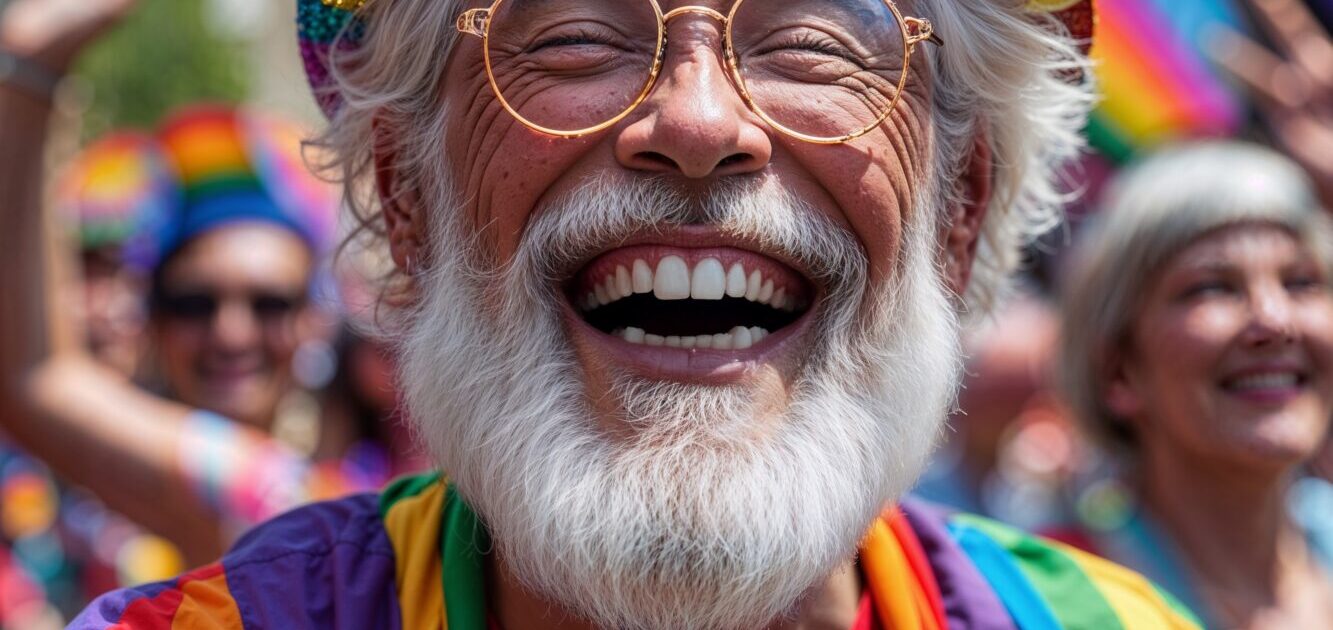
Jesus said: „For I was a stranger and you welcomed me.“ (Matthew 19:34)
My thoughts on Pride Month
What does Pride Month mean today – why is this month of June still important?
He invites me to consider the following fundamental points:
Why does one facet of human life receive or require so much attention?
I, Esther, have been living more or less openly as a lesbian for 40 years.
That wasn't easy in the past, when prejudice and defensiveness prevailed. Today I'm happy that it's much easier and more natural to be "queer"—a term that didn't even exist when I first came out as a lesbian.
And yet my perfectly normal lifestyle is still, or once again, being publicly discussed. This tires and exhausts me. For example, I still hear that being queer is a choice.
No, it isn't. The only decision I have to make again and again has been: how openly do I deal with it, how much do I reveal to the outside world?
🌈 A public sign of democracy
Something I never would have thought before: How we talk about queer people also says something about the state of our democracy. I was deeply moved when, a few days ago, the 82-year-old Austrian Federal President Alexander Van der Bellen, together with his wife Doris Schmidauer, wished everyone a Happy Pride Month (IInstagram link) and emphasized that queer rights are human rights.
At that moment it became clear to me: being queer is not a fringe issue, but a question of how one lives one's life. It has also become a measure of freedom, just like women's or children's rights.
It is therefore not surprising that hate comments and criticism of alternative lifestyles are becoming increasingly prevalent, especially in totalitarian or very conservative circles.
Sometimes it seems as if queerness touches on something that scares people.
And yes — many of the loudest voices against queerness come from men.
In a world where masculinity is confused with dominance and domination, many men may not be able to accept that gay men desire other men – that their traditional gender roles are challenged. Perhaps out of fear of being treated the way they themselves see and treat women.
But quite honestly: This explanation is not enough for me.
Because the pain, the defensiveness, the harshness that some people display runs deeper. Queer people, too, sometimes have such a defensiveness towards their own lifestyle.
Yes, we too sometimes struggle with homophobic tendencies. Coming out doesn't automatically turn you into a carefree, rainbow-loving, queer-positive person.
And that's exactly what makes me ask: What does queerness touch within us — and why does it feel so deeply wrong and alien?
📖 Jesus and the Stranger: An Invitation to Healing
In the Works of Mercy (Matthew 25) it says: „I was a stranger and you welcomed me.“ These words appear in a scene where Jesus describes the Last Judgment, according to which he will ultimately judge humanity. And the surprising thing is: neither morality, nor biblical knowledge, nor style of piety are decisive for the judgment – but rather concrete actions: how one treats other people.
He gives several examples of good deeds, and one of them is: sheltering strangers.
In the end, Jesus sums everything up: „Whatever you did for one of the least of these brothers and sisters of mine, you did for me.“
This means that if something or someone is unfamiliar to me, Jesus invites me not to reject it or him/her, but to welcome it. Queer people may be unfamiliar – and that is precisely where Jesus' invitation begins: not to fear strangers, but to welcome them.
Our instructor for meditation and spiritual guidance, Franz Xaver Jans-Scheidegger, expanded on this idea: We should not only look at and embrace the foreignness outside ourselves, but also the foreignness within ourselves. Perhaps also the inner impulse that immediately cries out to those who are queer: "That's impossible!" – and which reveals more about ourselves than about others.
🧡 When freedom hurts
It was precisely at this point that something clicked for me. Because the longer I thought about it, the clearer it became: The resistance many people feel towards queerness often has surprisingly little to do with queer people themselves – and a great deal to do with their own history.
Dagmar, for example, says that her most important coming-out was not being queer, but saying yes to her vitality.
She grew up as the grandchild of war survivors; at home, there was hardly any laughter or celebration. Her parents were overwhelmed by the wildness of their young child, by her liveliness and zest for life. Exuberance was forbidden; it was embarrassing and, according to her parents, only proved that they hadn't raised their child well. Even as an adult, Dagmar sometimes found it difficult to simply tolerate and allow this kind of exuberance in others because it felt somehow wrong—even though she fundamentally wished and desired this kind of vitality in everyone.
Psychologically, this is a well-known pattern: those who were restricted as children carry this restriction with them — and at the same time long for exactly what was forbidden.
Being queer is often similar. If you've learned that there's only one "right" way of life (the right man with the right woman), then the freedom of others can seem like background noise. It's a reflex: „"This cannot be allowed."“
And yes — this applies to us too. We, too, who are queer, carry unhelpful thoughts within us. We too sometimes struggle with homophobic tendencies, and we too find it difficult, after the initial "yes" to ourselves, to keep saying it again and again. To keep getting up and moving forward.
✨ Pride as an inner movement
Perhaps that is the real invitation of Pride Month: to be allowed to be more colorful, louder, more vibrant – and more honest.
Spaciousness begins where we no longer push away the unfamiliar within ourselves. Pride reminds us that openness, life, and love are not only found where everything is familiar, but also precisely where we are ready to open ourselves to the unfamiliar or to our own longing (provided it is healing).
That's why Pride Month is still important to me today.
Happy Pride Month!
 Billy McDonald, iStock -2189417472

 English (UK)
 Deutsch